Author name: Gary Furr

7 Steps to Accelerated Business Growth: Step 1 – Finding Clarity Of Direction
Seven-Steps-to-Accelerated-Business-Step-One

I have yet to meet a business owner who doesn’t say they want to take their business to the next level and make money in the process. To help them achieve their goals, I’ve developed a 7-step method to help business owners visualize and implement the future they want, and it all begins with Step 1: clarity of direction. Click on the link at the end of this post to view other episodes in this series. You can read Step 1, or click to listen.

Read or Click to Listen

Clarity of direction is knowing where you want to be in the future—where you want your business to be and where you want your personal life to be. The first step in any journey is deciding where you want to go. When I board an airplane, I know my destination—in fact, the destination guides the boarding process.

Your business and personal life are no different. You need to set a vision for the future and describe it to yourself. Write it down. Be specific. What will it look like? This is clarity of direction.

Charting a Course

In the story of Alice in Wonderland, Alice is looking for a way out of Wonderland. When she comes to a crossroad, she turns to the Cheshire Cat sitting there and says, “Which way ought should I go?” And the Cheshire Cat tells her that it depends on where she wants to be. Alice says she doesn’t know, and the Cheshire Cat, smiling, says, “Then it doesn’t matter which way you go.”

Without a clear direction, you’ll be just like Alice. It doesn’t matter which road you take if you don’t know where we want to go. But of course it’s unlikely you will end up where you want to be. Surprisingly, few business owners take the time to set a destination for their business (or for their personal life). How can you define success if you don’t know exactly what you want the future to look like?

Not only do you need to know where you want to go, you have to know where you are currently if you are going to get from A to B. A is your current state, and B is your destination or desired future. To chart a course, you must be truthful about where you are. No pretending. No denial. If you took a 30,000-foot view of your business and your personal life, how would you describe it? That’s your current state. Understanding that is a critical part of charting a course to the future.

Planning Backwards

Once you’ve identified your current state as well as where you want to go, then you want to go out five years from now and describe what that is going to look like for you in your business and your personal life. How many employees do you want to have? How much money do you want to make? How big of a business do you want? How many weeks of vacation do you want to take? Describe it in writing but stick to about six or seven items. Then work backwards from that.

If you want to be at this particular future state in five years, where do you need to be three years from now? Write that down as well. Use the same six or seven items and describe what each looks like in three years. Then work backwards again: Where do you want to be a year from now? If you need to be at a certain point in three years, where do you need to be a year from now?

Don’t allow your “small” business to make you small-minded. You didn’t start your business by thinking small, and you didn’t get into business just to do okay. Give yourself permission to dream big. Do it, and then write it down, because once you do, your subconscious mind goes to work to start to make those things happen.

I suggest to my clients that they read these five-year, three-year, and one-year visions every day. Doing so is a powerful tool for creating the future you want and putting your subconscious mind to work for you.

Clarity of direction is the all-important first step (of seven) in growing your business and making more money. When you’re ready to take the next step in your business’s growth, call Gary at 503-312-3145 for more information.

Click to view other episodes:
Seven Steps to Accelerated Business Growth Series

--- END POST ---

Something to Talk About

Something to Talk About

Do you enjoy making recommendations? On my last trip to Shanghai, I went out to dinner with a group of expats to a restaurant called People 7. The person who made the reservation was given a two-digit code: 64. When we approached the restaurant, all we could see was a concrete wall with an opening. There were no lights and no signage— just a dark staircase lit by candles, leading up to a grouping of nine lights in three rows of three.

One member of our party reached out and touched the 6th light and the 7th light, and a door opened on our right, revealing nothing more than a mirror: we had gotten the two-digit code wrong. He then pressed the 6th and 4th lights, and a door opened on our left letting us into the restaurant packed with patrons. The restaurant does no advertising, and there isn’t even signage or lighting to alert people to its presence. It’s all word of mouth.

PLEASE DON’T TELL

Recently I was in Chicago for a conference and had the opportunity to listen to Jonah Berger, PhD, a researcher for the Wharton School of Business. Dr. Berger is the author of two books, Contagious: Why Things Catch On and Invisible Influence, and he was discussing social currency. Dr. Berger told an interesting story of a hot dog stand in New York City marked with a large hot dog–shaped sign with the words “eat me” written in what appears to be mustard. A long flight of stairs leads down to a hole-in-the-wall restaurant offering 17 varieties of hot dogs. But sitting in the corner of the restaurant is a vintage phone booth with a classic rotary phone. If you pick up the phone and dial the #2, release it, and hold the receiver to your ear, a voice will come on the other end of the line and ask, “Do you have a reservation?” Of course you do not have a reservation, but today is your lucky day and apparently they can let you in. The back of the phone booth then swings open and you are allowed to enter a secret bar called “Please Don’t Tell.” No signs, no advertising—just an entrance through a small phone booth—and the bar is always packed. It has never advertised, yet it is the most sought after drink reservation in New York City, according to Dr. Berger.

Jim Meehan, the brains behind “Please Don’t tell” says, “The most powerful marketing is personal recommendation. Nothing is more viral or infectious than one of your friends going to a place and giving it their full recommendation.”

According to Dr. Berger’s research, 40 percent of what people talk about is their personal experience or personal relationships. People are more than willing to share their opinions and experiences, and there is substantial research and science behind the reasons why. Clearly word of mouth is a prime marketing tool for business.

What are your clients and customers saying about you? Have you asked them why they like to do business with you? When was the last time you actually talked to your customers or clients? Do you call them rather than emailing them? Have you asked them for a referral?

The more your clients or customers hear from you, the more they can buy from you. If you would like to find out how to increase your revenue and grow your business by word-of-mouth advertising, give us a call.

--- END POST ---

Winning Like a Formula One Team

WINNING LIKE A FORMULA ONE TEAM

In April I was invited to attend the Formula One Races in Shanghai with a group of expats. I had planned to be in China to continue work on a project there, so attending the races came at just the right time.

In preparation for the race I watched the Melbourne race on TV two weeks prior. Watching on TV is exciting because you can see the entire race as it unfolds, but being at the race in person is undeniably more exciting. Watching the cars come down the back stretch at 220 mph, apply their breaks within what seems like an impossible distance to make a hairpin turn at 47 mph, then accelerate back to top speed before entering another turn is thrilling. The track in Shanghai is 3.4 miles long, and the cars would make a lap in one minute and 31 seconds.

Formula One may be about racing, but it’s also a business, and watching these races got me thinking about the road to success. There are three main areas that any successful business and race team have to master: people, systems and processes, and product and services.

PEOPLE

We must have good people to accomplish the work. As Jim Collins said in his book Good to Great, we have to have the right people on the bus and in the right seats. Nothing of significance is accomplished by one person alone. The F1 teams are made up of some of the best. There is a lot of money at stake with every race (an F1 car costs about $10 million), and it requires a team of good people—just like your business does.

SYSTEMS AND PROCESSES

We must have systems and processes for the work to get done well, and on time. The precision with which the work gets done during a race is impressive. A car comes into the pit and the pit crew changes all four tires in 2.5 seconds. Repetition is the mother of all skill, and these teams practice relentlessly until they get it right and can repeat it consistently. They follow a system and a process to create perfection. All businesses require a system and a process for how work gets done. These systems and processes create consistency and eliminate chaos, which is the enemy of efficiency. Just ask any F1 pit crew.

PRODUCTS AND SERVICES

To compete in an F1 race, each team has to have the very best products (cars). There’s not just money at stake here, but the safety of the drivers. The competition is fierce, but the situation isn’t much different for business owners. Competition is fierce and without outstanding products and services, the race will be won by the competition.

If you are wondering how to develop an F1 team in your business—with the people, systems and processes, and products and services necessary to beat the competition—give us a call.

503-312-3145

garyfurr@garyfurrconsulting.com

--- END POST ---

Resilience

                                            RISILIENCE

Much is made of the need for creativity, innovation, and speed in the quest to build a successful business and stay on top, but lately the concept of resilience has come to my attention again and again. It started when I interviewed a successful businessman for a book I am writing and we discussed his path to success. As we talked, I realized that he had been incredibly resilient in facing the struggles he encountered throughout his career.

Not long after that interview, I had the opportunity to listen to Dr. Martin Seligman discuss the practice of positive psychology at the Summit Consulting Group’s Million Dollar Convention in Atlanta. He shared many insights and ideas that I found valuable, but I was particularly struck by his assertion that “resilience is twice as important as talent and IQ.”

When I returned from the conference, I was browsing in Powell’s Books and noticed a book entitled Resilience by Eric Greitens, a former Navy Seal. The title caught my attention. In his book he says: “Resilience is a virtue that enables us to move through our hardships and become better. None of us can escape pain, fear or suffering. Yet from pain can come wisdom, from fear can come courage, and from suffering can come strength, if we have the virtue of resilience.”

Pain can break us or make us wiser. Suffering can destroy us or make us stronger. Fear can cripple us or make us more courageous. It is resilience that makes the difference.

Tony Robbins states that too many of us are living in a suffering state and the antidote to a suffering state is to quit making it about ourselves. He also says that life is too short to live in a suffering state. We need to break the pattern, we need to be resilient.

In my good friend Sandra Suran’s book The DNA of the Resilient Organization she describes how resilience and sustainable growth within an organization are built from the core. With each problem that is solved or new opportunity that is seized and accomplished, the organization’s core becomes stronger.

In Dr. Seligman’s words, Sandra Suran’s book, and Eric Greitens’s book, the message is unanimous: If we deal with our problems and struggles correctly, they make us not only stronger individuals but stronger organizations. We must learn to honor the struggle because it is part of our journey as individuals and organizations and necessary for real growth.

Resilience is the key to success and a well-lived life. It is not what happens to us that has the greatest impact, but our response to what happens. If we want to be happy, we need resilience. If we want to be successful in business, we need resilience.

If you want to be more resilient in your business and achieve greater success, we can help you. Dramatically improving individual and organizational success is our business.

--- END POST ---

Albert Einstein 2

                                 ALBERT EINSTEIN 2      

In my last blog post I discussed a quote that has been attributed to Albert Einstein: “The definition of insanity is doing the same thing over and over again and expecting different results.”

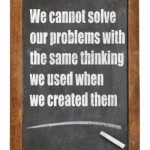
Another one of Einstein’s insightful quotes is: “We cannot solve our problems with the                                same thinking we used when we created them.”

As business owners we often try to solve problems by turning to our own knowledge. It’s understandable—we’re self-reliant, independent, and committed. Who knows our business better than we do? Who cares more about it than we do? But it’s that very self-reliance that can land us in trouble. Rather than seeking out greater knowledge and information, or engaging a mentor, expert, or other individual with some relevant experience and outside perspective, we tackle the problem ourselves. We use the same knowledge, experience, and level of thinking that got us into the problem to begin with; we do the same thing over again and expect different results.

Sometimes we just can’t see the forest for the trees. We’re stuck in the woods, but we need a bird’s eye view. It’s our thinking that creates the situations we find ourselves in, yet our thinking is so much a part of us that we can’t distinguish what is landing us in trouble. That is how we end up trapped in the insanity of doing the same thing over and over, expecting different results.

If we want a different outcome in business, we may need to step back and see it from a different perspective. This means proactively seeking new knowledge, including help from those around us.

Need help seeing your business from a different perspective? Give us a call. We can help. 503-312-3145    http://www.garyfurrconsulting.com


--- END POST ---

Albert Einstein

Albert Einstein                              ALBERT EINSTEIN

Albert Einstein has been widely credited with saying; “The definition of insanity is doing the same thing over and over again and expecting different results.” However there is absolutely no evidence that Einstein actually made this statement. Never the less, it is a great quote and most people we meet can easily repeat this statement.

However, few actually take it to heart. Many business owners will do the exact same thing they did in 2016 and expect 2017 to be a better year than the previous year.

Often business owners at the beginning of the year will say they want to make a 3- 5% increase in their business for the upcoming year. The problem with this statement is that it doesn’t really require thinking differently or doing anything different than the previous year to achieve this goal. A little tweaking here, a little tweaking there, a slight increase in sales, a little expense reduction at the same time and they can easily make a 3-5% increase in their bottom line results. Often these are practices that were already being done in the business anyway. So are they expecting different results while pretty much doing the same thing they did in the previous year? Have they really made any real changes in their business practices? Are they thinking differently moving forward? Most likely they have not made any real changes in the business but will expect great results. Incremental change isn’t going to take your business to the next level. We have to demand more of our business and ourselves.

What if we asked the question; What would it take to double my business for the upcoming year?

Asking the question, how can I double my business for this New Year requires us to think about our business from a different perspective. It can no longer be business as usual. It forces us to stop and think and look at our business from a higher level.  And in order to effectively think differently about the business, we have to step back from the business to really see what is going on. If we want to double your business for the upcoming year, it can’t be business as usual. You have to do something different beyond tweaking here and there.

Where do we want your business to be a year from now? What are you going to do differently this year then you did last year to make a dramatic change and double that business? What is it that is preventing you from reaching the next level of success in your business and personal life? Do you know what it is? Have you reflected on the last year to examine what you did well and what you can improve on moving forward? Have you determined what prevented you from achieving the level of success that you wanted to achieve at the beginning of the year? Are you going to do the same thing this year and expect different results?

Do you want to make dramatic improvements in your business for 2017?

If you truly want to make a difference and take your business to the next level, then give us a call. You don’t have to go it alone and without a guide. We are here to help.

Take massive action today to improve your business in 2017!

http://www.garyfurrconsulting.com

http://garyfurr@garyfurrconsulting.com

--- END POST ---

Make 2017 YOUR BEST YEAR EVER!

Make 2017 YOUR BEST YEAR EVER!                    

 As you approach a New Year, it is a good time to reflect on 2016 and ask yourself some serious questions. This will lay the groundwork for a fabulous 2017. Year-end planning for the upcoming year is the best way to get better results. If you make a good start to the New Year, you will most likely have a good finish next December.

Here are some questions to ask yourself to prepare for an even better year in 2017. Take some time to think about these questions, and be honest with yourself. Without honesty, this will be a fruitless exercise.

  1. What went well this year?
  • List the things that you accomplished.
  • Compare the list to the goals that you set for 2016.
  • How did you do? What can you do better?
  1. What didn’t go so well this year?
  • What can you improve on moving forward?
  • What strategies have you already tried to improve your business that worked or didn’t work?
  1. What do you want to accomplish in this New Year?
  • What is your vision for 2017, 2018, and 2019?
  • What will be your goals be in the next 90 days to help you accomplish your vision?
  • What do you think you need to do to double your business this year?
  1. How can you develop more clarity of direction?
  1. How can you develop a relentless focus to succeed?
  1. How can you become more disciplined to accomplish your goals?
  1. How can you make 2017 the most extraordinary year ever?

These are just a few of the questions you can ask to prepare for a prosperous 2017. The coming year will turn out as you choose. Your beliefs matter. Choice, focus, and intention all play their role. In business, things don’t just happen. Without belief and without goals, you won’t put in the necessary effort or resources.

We can help you plan for the most successful year ever. Give us a call.

We are here to help you achieve dramatic success in 2017. http://www.garyfurrconsulting.com

--- END POST ---

Have a Successful Close to 2016

                 Have a Successful Close to 2016


2016 is coming to a fast close.

How will you finish out the Year?

Have you accomplished your 2016 vision?

How are you doing on your Q4 90-day goals?

Are your financials in order?

Will you make more money this year than last?

How has your cash flow projection worked out? Where you close?

If you are having trouble answering these questions, then it is most likely because you have not been clear on the vision and direction of your company for 2016. In order to reach our targeted desired future, we need to know what that future looks like. I have discussed many times the need to have clear direction as to where we want our business to go in the future. Without a clear direction it is unlikely we will arrive at our desired destination. Was your vision for 2016 clear? Did you review it often, everyday so that your subconscious mind could go to work to help you achieve the results you desired?

We have discussed the need to break this one-year vision down into smaller increments called 90-day goals. We have a few weeks left to accomplish our Q4 goals. How are you doing? Are you on track? Have you been reading your goals everyday?

You have one month left for you final push to achieve your desired results. Don’t give up, keep pushing, and keep moving forward. There is still time to make 2016 one of your best years ever. Remember that revenue growth is a proactive activity. We can’t wait for it to fall into our laps. We have to take action.

Remember what Henry Ford said: “Whether you think you can, or think you can’t, you’re right.” Believe that you can make a difference this year compared to last year. Choose to believe. It’s a choice. 80% of success is in our own minds. It’s up to us. Your beliefs control your actions, choose to believe.

Make that final push to finish your year strong. Lets get together to ensure a good finish to your 2016 and start planning for an even more successful 2017.

http://www.garyfurrconsulting.com

--- END POST ---

The Essential Steps to Business Success—Step Six

runner

Marathon runners know the fuel their bodies need to go the distance. No one attempts a long-distance run without the right energy to burn. For business owners, and their employees, that fuel is purpose—our sixth step in business success.


Step Six—A Higher Purpose or Cause to Believe In

Meaningful work or something to believe in is a powerful motivator for not only business owners but also the individuals they employ. We spend most of our waking hours working, so our work should be something we believe in, and something that will make a difference in our lives as well as the lives of our employees and our customers.

Human beings are wired for purpose and meaning. Once we get past Maslow’s basic needs on his hierarchy—food, clothing, shelter, and safety—we get to the need for connection and meaning. In order to have connection and meaning we need to be involved with an organization that creates an environment with common vision and purpose, or something bigger than ourselves, to believe in. Yes, individuals in our companies want to make money, but they also want to make a difference. When a business can answer this need for meaning and connection, employees win and the business wins.

What makes a business work is the why—the higher purpose and cause. Why we do what we do gives us the fuel to get through the inevitable ups and downs. It also provides fuel to our employees to persevere and compete at a higher level. Any business can work as long as everyone in the organization has the passion and intensity to keep going even in tough times. Since running a business takes tremendous energy, we need that vision of something bigger than ourselves to give us reasons and energy to scale the obstacles we face along the way.

What are your vision, mission, and values? Do they create something bigger than you and your organization to strive for? How will you make a difference?

If you are struggling with creating an empowering vision of the future, one that staff and employees can strive for, we can help you.

garyfurr@garyfurrconsulting.com

--- END POST ---

The Essential Steps to Business Success—Step Five

Customers

As we continue the discussion of the keys to business success, no business can survive without excellent customers. At the same time, no business can be all things to all customers. Success demands that you know who your ideal customers are. Here are some critical questions to ask yourself:


  • Who is your current customer and who is your most ideal customer?
  • Are they one in the same?
  • Are you serving that market?
  • Are you providing more value then your competition?

Success always comes down to the customer, which is why focusing on the customer is the next step in business success.

Step Five—Focus on the Customer

You are in business for one purpose only: To supply something that your customers perceive has significant value. Most likely there are other businesses in your same space competing for the same customers, so you out-perform and out-sell your competition by doing the following:

  • Knowing what your customers/clients want.
  • Providing massive value to your customers.
  • Remembering that you get paid for results and meeting customer needs—not for effort or good intentions.
  • Taking responsibility for the entire value chain.

How do you know if you have met the needs of your customer or not? You have to ask. You must not only discover if you have met their needs, but if you have done so in a timely, efficient, and hassle-free manner.

You can’t be all things to all customers, but all customers are looking for suppliers who make it easy to do business with them. All customers are also looking for you to be honest and to do the right thing—always. Make it fun to work with you and that’s the cherry on top.

If it sounds like a tall order, it is. But focusing on the customer like this is how you will stand out from the competition. How do you accomplish all of this? By first understanding who your ideal customer is and what they want. Your assumptions aren’t enough here; you have to do the research to find out.

Initial research isn’t enough either. Ongoing communication with existing customers is what keeps profit growing. You have to uncover whether you are indeed meeting customer needs by supplying what they want, when they want it, and in the condition they expect to receive it. The only way to know this information is to communicate with your customers regularly and to ask the right questions.

If you want your business to grow, then quit avoiding your customers. Rather than obsessing over what products and services you have to offer, obsess over your customers.

We can help you to grow your business by leaps and bounds without capital expense. Give us a call.

--- END POST ---

Scroll to Top